- Role
- Primary PM · cross-market requirements (Korea + Singapore)
- Company
- SkyLab Group
- Period
- 2025
- Stack
- Multi-tenant SaaS, Toss Payments, Lago, RAG pipelines
Core insight
The bet
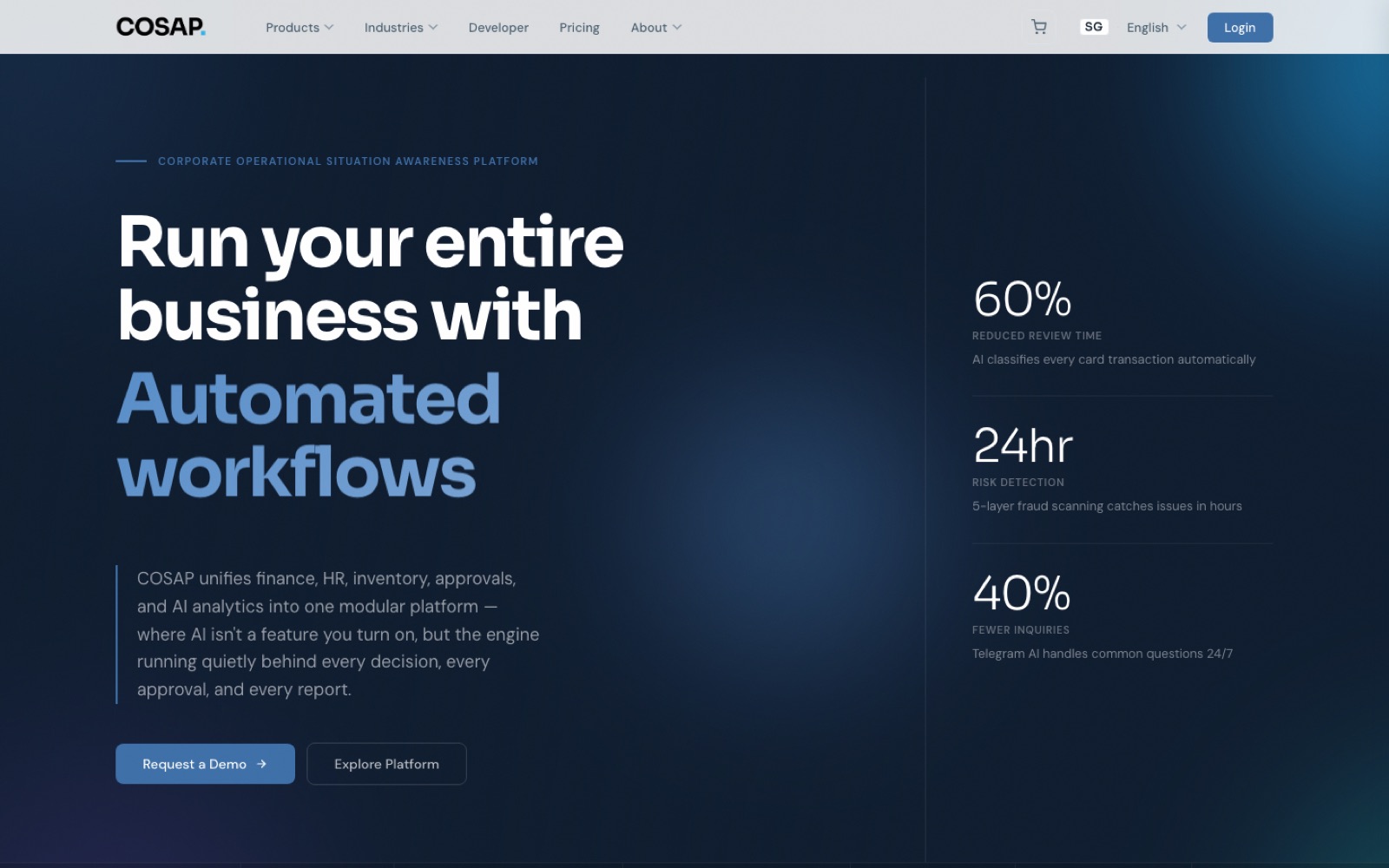
Small and mid-sized companies rarely lack software. They lack something that catches the error before it posts. COSAP is built around that idea: an AI-powered for Korean , positioned as an affordable alternative to SAP, covering accounting, legal compliance and payroll in one multi-tenant product.
- modules I led product design across
- 8
- client markets: Korea and Singapore
- 2
Source: Thao's CV (SkyLab, COSAP)
Why it matters
The problem
The company's launch material frames three leaks. Finance: closing the books takes 10+ days a month. Payroll: about 1 in 5 runs contains an error. Leadership: internal fraud can take a year to notice. Those are industry benchmarks the company cites (EY, APQC, ACFE), not measurements of mine.
Decision
The tension
SMBs will not rip out the ERP, accounting and HR tools they already run, and a new system means weeks of training. So the product stance became a layer above those systems, with Telegram as the everyday surface. Toggle the two pillars below.
The decision
Replace the company's ERP, or sit above it?
Sit above those tools and catch errors before they post, with Telegram as the everyday surface.
Source: COSAP company introduction deck v7, p.4 and launch deck v3, p.8 (confidential decks; paraphrased).
Regulated market
Compliance before the save
Korean and Singaporean clients carry different labor rules. Rather than audit policies afterwards, the product maps each employee to a country and blocks a non-compliant policy at the moment it is written, citing the law. Try it.
Cross-market
One work item, two languages
A Vietnamese employee justifies a Korean card expense in Vietnamese; the Seoul approver reads it in English. The company's line is that most apps translate the menu, while COSAP translates the work.
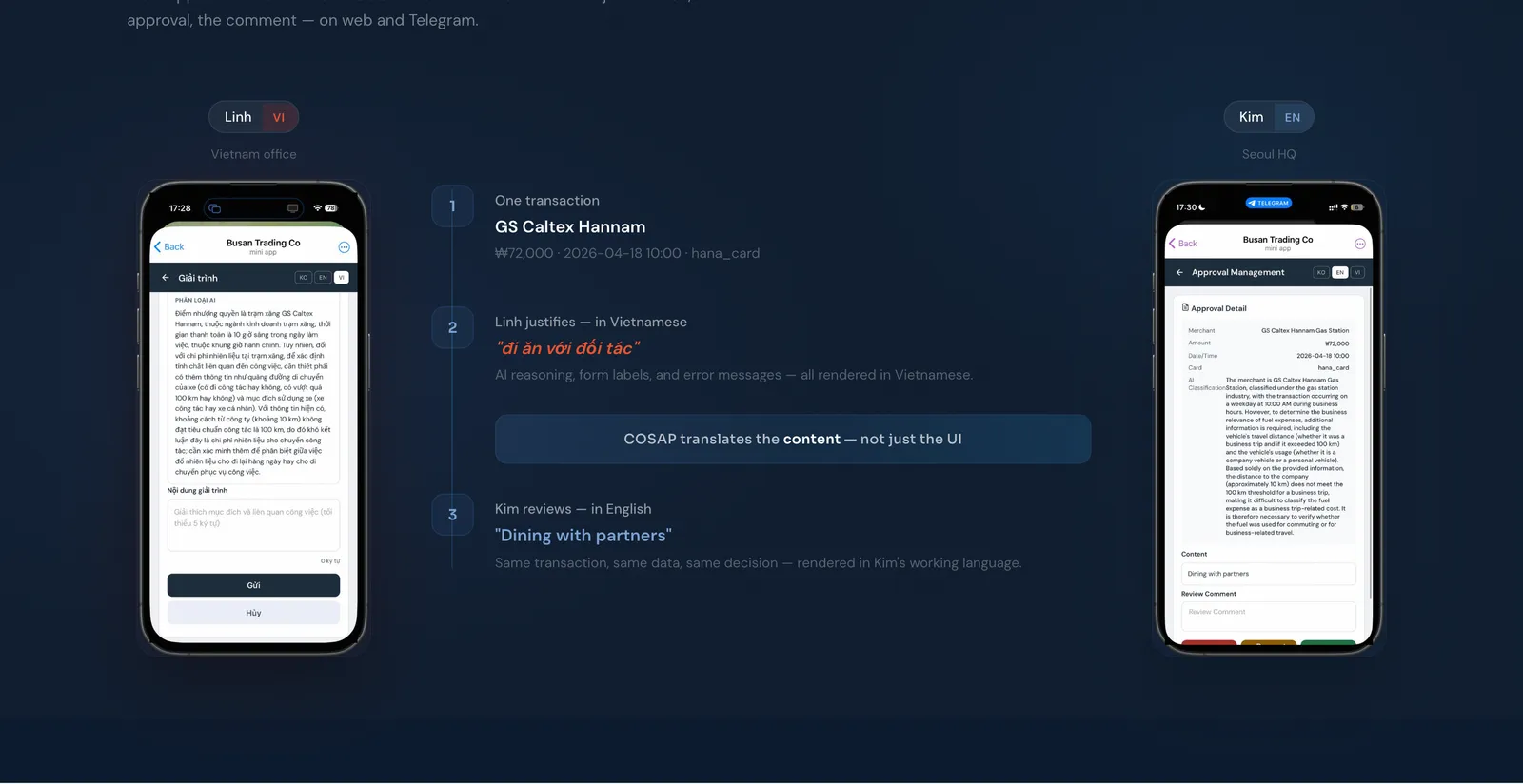
The same transaction, rendered for each reader
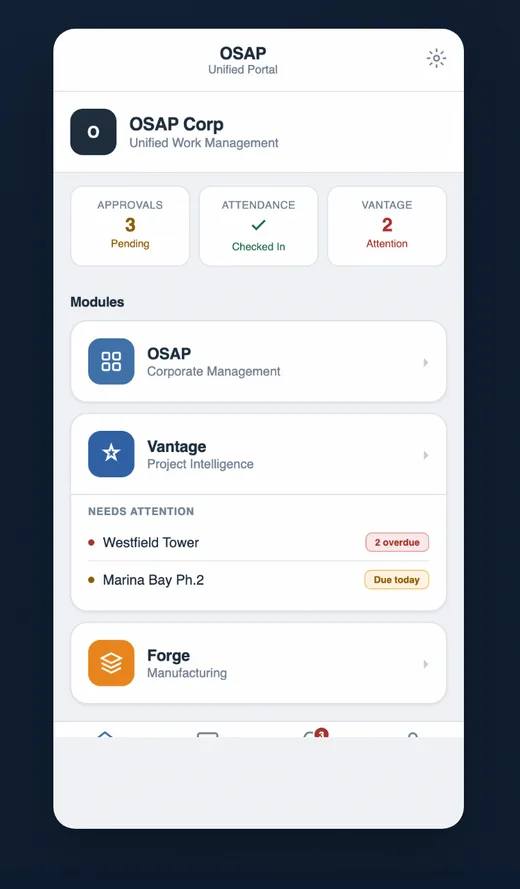
The Telegram portal
Company figures
What it did in the field
Two measurements the company reports. They describe the product at client sites, not my personal outcome, and the client is not named.
Forge at a manufacturing client: before vs after
Company figure- Purchase-order errors per month12.4−83%
- Time to flag an anomaly14.3 days
- On-time delivery73%
- Inventory turnover4.2×
Month-end close (hours)
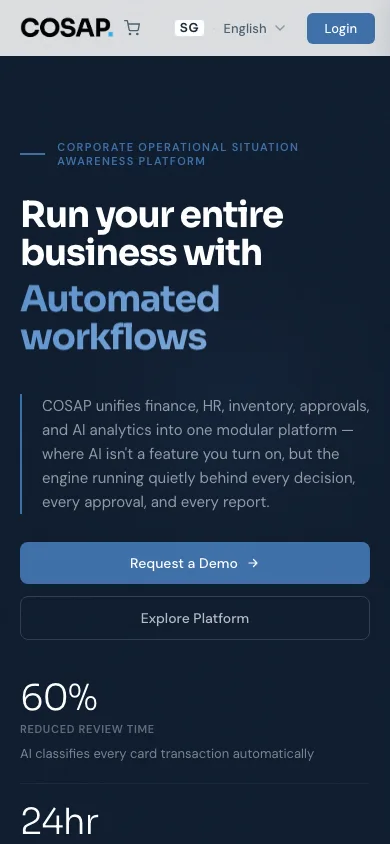
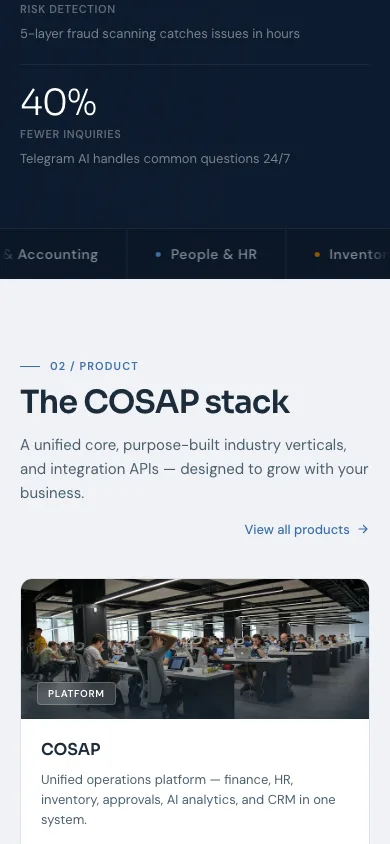
Company figureThe public site also advertises 60% less review time, risk detection within 24 hours and 40% fewer inquiries. Those are marketing claims from cosap.ai.
Ownership
What was mine
Mine
Primary PM for cross-market requirement gathering across Korean and Singaporean clients, and product design across 8 modules.
The team's
The AI engine, integrations and Forge deployments were built by the engineering team and its industry partners.
The company's
The figures above, the launch decks and the public site. I cite them; I do not claim them.
Results
- purchase-order errors per month at a manufacturing clientCompany figure
- −83%
- month-end close, from about three daysCompany figure
- ~4 h
- modules I led product design acrossMy CV
- 8
Source: COSAP company introduction deck v7, p.18 and launch deck v3, p.14 (company figures, client name withheld); Thao's CV (SkyLab, COSAP). The company figures describe the product at client sites, not my personal outcome.